
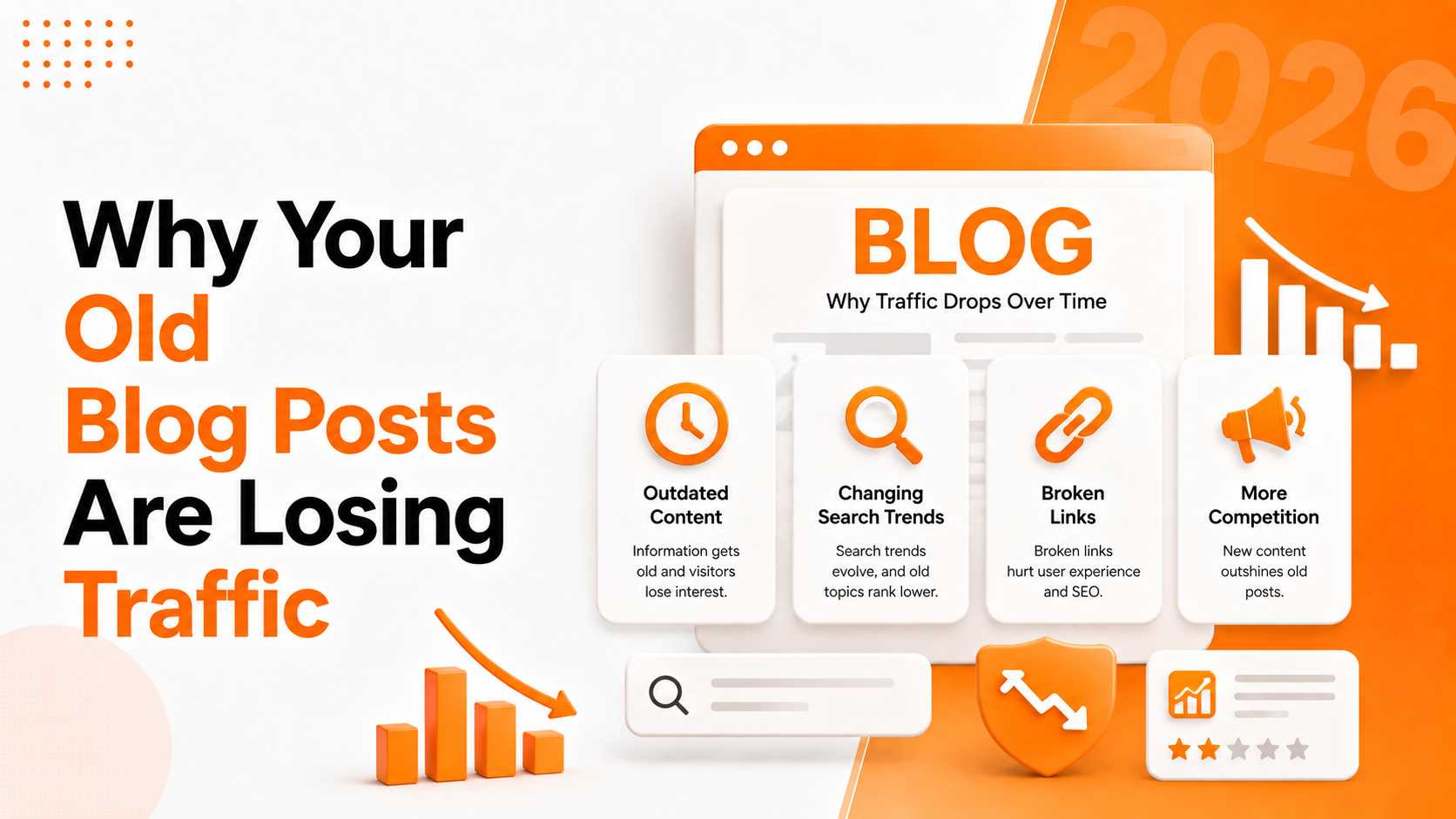
Why Your Old Blog Posts Are Losing Traffic
Have you observed that your previous blog posts are now fetching fewer views? This is one of the major challenges that plague many websites. Your blog could have been performing well for many months or even years.
However, traffic starts to decline gradually. A decrease in traffic is not necessarily a result of poor-quality content. Trends of search keep changing, and so do other factors such as the release of new competitor content and SEO upgrades by Google.
There might come a time when you will require to review your previous content. However, the positive side of the story is that it doesn’t mean that you should start from scratch in coming up with a new blog. You only require a content refresh on your previous blog post.
What Is Declining Blog Traffic
Declining blog traffic means a blog post is receiving fewer visitors from search engines than it did in the past. You may notice this through Google Search Console, Google Analytics, or another SEO tool.
A traffic drop can happen slowly or suddenly. A blog that once brought regular visitors may gradually lose clicks because newer and more useful pages have started ranking above it.
Some changes are easy to notice. Your keyword rankings may fall, impressions may decrease, or your page may still appear in Google but receive fewer clicks. These signs tell you that the page needs a closer look.
Finding the reason behind declining blog traffic is important before making changes. Simply adding more words or keywords may not solve the actual problem.
Why Old Blog Posts Lose Traffic
There are many reasons why blog traffic could decrease. There are also various factors that can influence the performance of an old blog post.
The most obvious one is that the blog post contains out-of-date information. If something used to be relevant and valuable two or three years ago, today you may have to update your examples, data, tools, or recommendations.
For example, if your SEO blog post was written several years ago, some of its tips may have become ineffective over time. The algorithms have evolved; people want to see up-to-date information.
The competition is also a key factor. There are always new websites being created, as well as competing sites that are creating fresh posts on similar topics.
As these pages get more recognition, your old blog post will gradually lose its place and start to receive less traffic.
Your Old Content May Need an Update
However, having older content on your site is not necessarily a problem either.
The issues start arising when vital pages remain neglected for a long period of time.
Data might become outdated due to industry evolution, development of customer demands, emergence of new tools, etc. Moreover, even the links that were functioning when you posted your article might cease to work by now.
If a user comes to read your article and sees outdated data, they will probably close the tab and look for a more recent source. Competing sites might provide newer information that will make your older page redundant.
That is why checking up on your older content should be included into your regular SEO activities.
How Content Refresh Can Help
Content refresh involves revising an already published blog rather than creating an entirely new one.
First, you need to read the blog like a fresh reader. You should evaluate whether the information presented in the article is up-to-date and if it fully addresses the readers' questions.
When refreshing your content, you will be able to:
- Fix out-of-date facts, examples, and other data
- Repair broken links and insert some valuable internal links
- Revise the headings, make it more readable, and improve the page structure
- Renew the title, meta description, and images
It is possible to add any information that was missing in the initial piece of content. Nevertheless, refrain from adding additional paragraphs only to increase its volume.
The main idea of a content refresh is making it more useful and relevant for readers.
Google SEO Updates Can Affect Your Rankings
SEO is constantly evolving and being updated by Google. Some SEO updates may influence the ranking of the blog posts published earlier.
Not all declines in traffic are connected with SEO updates; however, changes in the search results may show problems in the older content.
For instance, in case when Google starts to understand more about the valuable and comprehensive answers, it is possible that the site that repeats the keywords will face difficulties with the competitor site providing more informative content.
In case if you notice the decline in traffic for your blog after any significant changes in the search results, do not delete the post right away. First of all, review its content.
Check the Search Intent
Search intent is another important factor behind declining blog traffic.
Search intent simply means understanding what a person actually wants when they type a query into Google.
For example, someone searching for "best office paper" may want product suggestions, useful comparisons, and buying advice. If your article only explains what paper is, it may not satisfy that search.
Before starting a content refresh, search your target keyword and look at the type of pages appearing in the results. This gives you a better idea of what readers expect.
Ask yourself whether your article answers the main question clearly, covers important subtopics, and provides useful information.
You do not need to copy the top-ranking pages. Instead, look for areas where your article can offer clearer explanations or additional value.
Improve the SEO of Your Old Blog
SEO is not simply about having keywords in the article. It’s also about structuring your page in such a way to provide a good reading experience.
When checking older articles, you need to determine if your main keyword and other supporting terms are used naturally in the content.
You may also consider analyzing the page title, headings, meta description, internal links, images, and URL.
Try to make your article more scanable and explain all necessary information clearly. Don’t try to repeat your keywords in every paragraph since it can negatively impact the readability of the article.
Keyword stuffing is not a solution; it makes the article unnatural and less pleasant to read.
Update Your Blog Title and Headings
Sometimes a drop in blog traffic is associated with decreased clicks rather than just a reduced ranking.
Even though your website appears in Google search results, users tend to pick another option, since its title seems more relevant.
While refreshing your content, try to look at your title and ask yourself if it properly reflects what people will get from reading the article.
Headings are important as well. Well-formulated headings not only allow visitors to quickly locate needed information, but they also make long articles easy to read both on computers and on mobile phones.
A small change in your title or headings will make an old article feel up-to-date.
Signs Your Old Blog Needs an Update
Not every old article needs a complete rewrite. Some pages only need small improvements. However, certain signs show that a page deserves attention:
- Organic traffic and keyword rankings are falling
- Competitors are providing newer information
- The content no longer matches search intent
- Important facts, examples, or links have become outdated
If you notice several of these signs, the page can be a good candidate for a content refresh.
Do Not Delete Every Old Blog
However, when faced with declining blog traffic, it is wrong to remove the old page.
It is possible that some old blogs have valuable backlinks, search impressions, keywords, and information worth improving.
Instead of deleting the page, it is necessary to first look at the possibility of rejuvenating it by adding new fresh content.
In case you have two articles that cover similar subjects, it may be wise to merge them.
Sometimes one useful page is better than many similar pages.
You need to evaluate traffic, rankings, backlinks, and overall value of the page.
Keep Your Blog Updated Regularly
The content refresh is an ongoing process. It should be integrated into your SEO process.
It is not necessary to refresh all blogs on a monthly basis. It is better to choose the pages which used to be successful but have lost their power because of decreasing blog traffic.
It is also a good idea to check older pages with backlinks or search impressions. You can get the most out of your past efforts thanks to page refreshing.
In addition, regular checks allow for spotting outdated information timely.
Track Results After a Content Refresh
Give your page some time to show its response after the changes have been made. There may be some lag time in ranking responses for the search engines after the changes.
Measure organic clicks, impressions, keyword rankings, and other relevant metrics before and after your content update.
In case the declining blog traffic persists, then there may be other factors causing the problem like increased competition, decreased search demand, technical SEO issues, or even changing search intent.
Final Thoughts
Declining blog traffic doesn’t necessarily mean that the old blog post is no longer of any use. Most often, it means that it is necessary to update the blog post to correspond to modern information, user intent, and audience expectations.
A good content update strategy will be able to enhance outdated parts of the blog post, incorporate new information, fix any dead links, increase the number of internal links and make the blog post more readable.
Rather than ignore old content, analyze its performance and figure out how you can make it more helpful. Pay attention to new trends and changes in SEO algorithms, as well as to your competitors’ activity.
The purpose is not to make your old blog longer. It is about making it more helpful for those users who are looking for this type of information right now. With proper monitoring and constant updates, it is possible to decrease blog traffic drop.
Blog FAQs
Frequently Asked Questions
Old blog posts can lose traffic when information becomes outdated, competitors publish better content, search intent changes, or Google introduces new SEO updates.
A content refresh updates outdated information, improves readability, adds useful details, fixes links, and makes the blog more relevant to current readers and search intent.
There is no fixed schedule, but important blog posts should be reviewed regularly, especially when rankings, traffic, industry trends, or search behavior start changing.
A drop in traffic does not mean you should remove the blog. If it still has useful information, backlinks, or ranking potential, updating the content can help improve its performance instead of starting over with a new page.
Yes, SEO updates can affect search visibility, but they are not the only reason for declining blog traffic. Competition, outdated content, and changing search intent can also play a role.