What Are LSI Keywords? Understanding LSI Full Form in SEO
If you are learning SEO, you may have heard terms like LSI keywords, semantic keywords, related keywords, and keyword variations. But what do these terms actually mean, and how can they help your content?
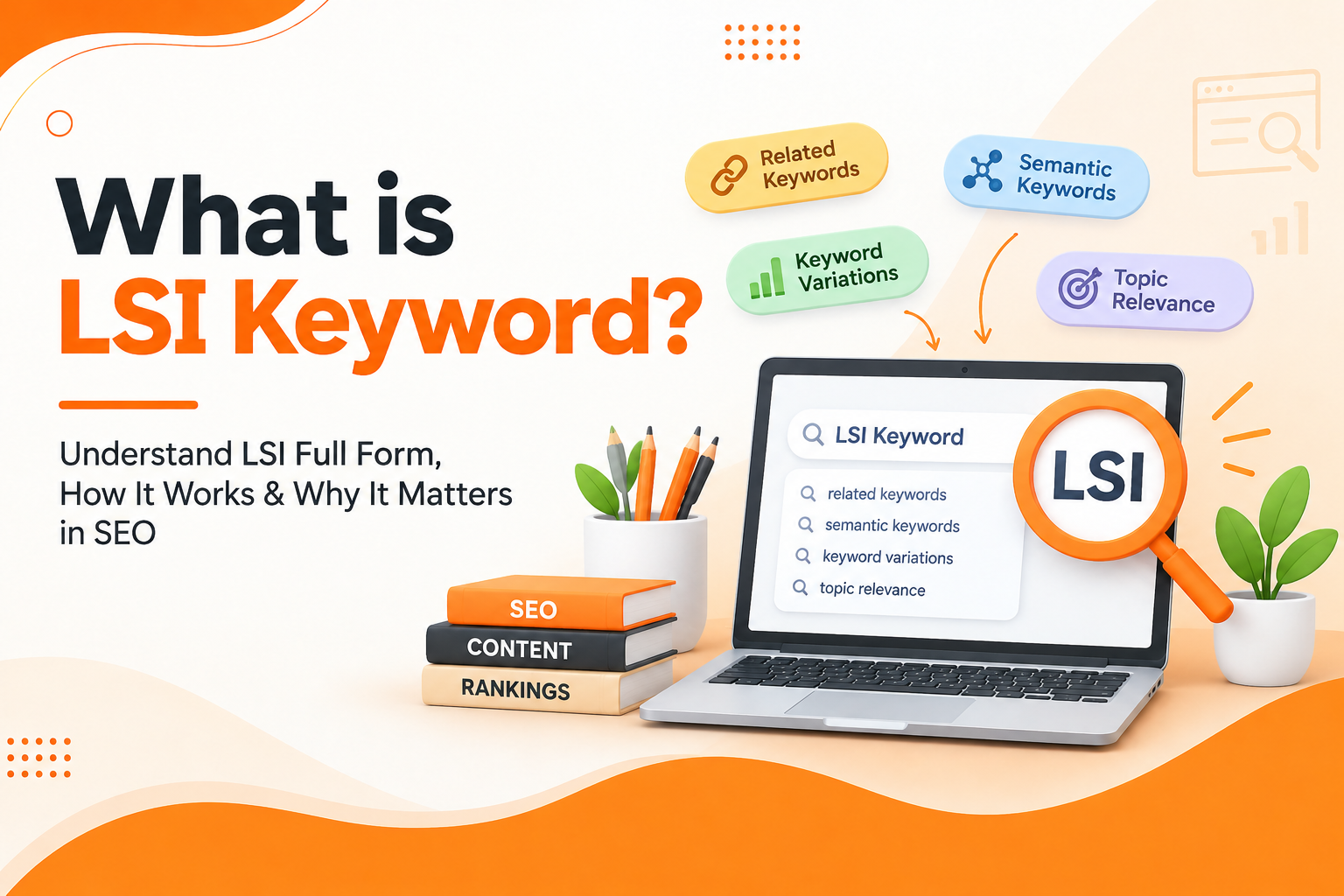
The LSI full form in SEO is Latent Semantic Indexing. In simple words, LSI refers to a method of understanding the relationship between different words and topics within content. However, the term “LSI keywords” is commonly used in SEO to describe words and phrases that are closely related to the main topic of a page.
For example, if your main keyword is “digital marketing,” related terms could include SEO, social media marketing, PPC, content marketing, Google Ads, and online advertising.
In this guide, we will understand what is LSI, how LSI keywords work, how to find them, and whether you should use an LSI keyword generator for your SEO strategy.
What Is LSI in SEO?
The LSI full form in SEO stands for Latent Semantic Indexing. LSI is a mathematical technique that was developed to identify relationships between words and documents based on the context in which those words appear.
In SEO, however, the phrase LSI keywords is generally used in a broader and simpler way. SEO professionals often use it to describe related terms, topic variations, and semantic keywords that help search engines understand what a page is about.
For example, suppose your primary keyword is “Apple.”
The meaning of Apple can be confusing because it could refer to the fruit or the technology company. If your content contains words such as iPhone, MacBook, iOS, iPad, and App Store, the overall context makes it clear that your article is about Apple the company.
This is where related and semantic terms become useful.
Why Are LSI Keywords Important for SEO?
Understanding the LSI full form in SEO is useful, but knowing how related keywords support your content is even more important.
Search engines do not look at only one keyword when understanding a webpage. They can analyze the overall topic, context, entities, phrases, and relationships between different words.
Using relevant related terms can make your content more complete and easier to understand.
For example, if you are writing about “SEO audit,” naturally related terms could include:
- Technical SEO
- Website audit
- On-page SEO
- Backlinks
- Crawl errors
- Indexing
- Core Web Vitals
- Keyword research
- Internal linking
You do not need to force every term into your article. The goal is to cover the topic naturally and provide useful information to readers.
LSI Keywords vs Semantic Keywords
People often use LSI keywords and semantic keywords interchangeably, but there is an important distinction.
The term LSI comes from Latent Semantic Indexing, which is a specific information-retrieval technique. Modern search engines use much more advanced systems for understanding language and search intent.
Therefore, when SEO professionals talk about LSI keywords today, they usually mean related or semantically connected keywords, rather than actual LSI technology.
Semantic keywords are words and phrases that are connected to the meaning and context of your primary topic.
For example, for the topic “running shoes,” semantic keywords may include:
- Running sneakers
- Sports shoes
- Road running
- Cushioning
- Trail running
- Athletic footwear
- Running shoes for beginners
These terms help create topical depth without repeating the same keyword again and again.
How Do LSI Keywords Help Your Content?
The LSI full form in SEO may sound technical, but the practical idea is quite simple: create content that clearly covers the topic.
Here are some ways related keywords can improve your content:
1. They Improve Topic Relevance
When your article naturally includes related terms, it gives search engines more context about the subject.
For example, an article about Google Search Console can naturally discuss indexing, search queries, impressions, clicks, pages, coverage, and performance.
2. They Reduce Keyword Repetition
Repeating the exact same keyword too many times can make content difficult to read.
Instead of repeatedly using one phrase, you can naturally use variations and related terms.
This creates a better experience for both readers and search engines.
3. They Help Cover Search Intent
People may search for the same topic using different phrases.
For example, someone interested in SEO tools may search for:
- Best SEO tools
- SEO software
- SEO tools for beginners
- Keyword research tools
- Website SEO checker
Understanding these variations can help you create content that answers more questions around the same topic.
How to Find LSI Keywords?
You do not always need a paid tool to find related keywords. There are several simple methods you can use.
Google Search
Start typing your main keyword into Google and check autocomplete suggestions. You can also look at the People Also Ask section and related searches.
These suggestions can provide useful ideas about what users are searching for.
Competitor Analysis
Search for your target keyword and analyze the pages ranking on the first page.
Look at their headings, subtopics, FAQs, and commonly used terms. Do not copy their content. Instead, identify useful topics that your own article should cover.
Keyword Research Tools
Many SEO platforms provide related keyword suggestions, keyword variations, and topic ideas.
You can also use an LSI keyword generator to quickly generate related terms around your primary keyword.
However, do not blindly add every keyword suggested by a tool. Always check whether the keyword is actually relevant to your topic and audience.
What Is an LSI Keyword Generator?
An LSI keyword generator is a tool that provides words and phrases related to your main keyword.
For example, if you enter “content marketing,” the tool might suggest terms such as:
- Content strategy
- Blog content
- Content creation
- Content distribution
- Audience engagement
- Content promotion
These suggestions can help you find additional topics to cover.
The important thing is to use these suggestions naturally. SEO is not about inserting as many keywords as possible. It is about creating useful, well-structured content that satisfies the search intent.
Should You Use LSI Keywords in Every Article?
You can use related and semantic keywords when they genuinely make your content better, but you should not treat them as a checklist.
If you understand the LSI full form in SEO, you should also understand that modern SEO is much broader than simply adding related words.
Focus on:
- Search intent
- Helpful and original information
- Clear content structure
- Relevant entities and topics
- Internal linking
- Good user experience
- Accurate information
- Natural keyword usage
Write for people first and optimize for search engines naturally.
LSI Keywords and Keyword Density
Keyword density is the percentage of times a keyword appears compared with the total number of words on a page.
However, there is no magic keyword density percentage that guarantees higher rankings.
If you are targeting a phrase such as “lsi full form in seo,” use it where it makes sense, especially in the introduction, relevant headings, body content, and FAQ section.
Do not repeat the phrase unnaturally just to reach a specific percentage. Keyword stuffing can make your content look artificial and reduce readability.
The better approach is to maintain keyword proximity and topical relevance. Keep related words close to the main topic when they naturally belong together.
LSI Keywords vs Primary Keywords
Your primary keyword is the main search term you want a page to target.
For example:
Primary Keyword: LSI full form in SEO
Related terms could include:
- What is LSI
- LSI keywords
- LSI keyword generator
- Semantic keywords
- Related keywords
- Latent Semantic Indexing
- Keyword variations
- Search intent
Your primary keyword tells you the main topic, while related terms help you build a complete article around that topic.
Final Thoughts
Understanding the LSI full form in SEO can help beginners understand why related terms and topic relevance matter in content creation.
Although “LSI keywords” is a popular SEO term, it is more accurate to think of them as related or semantic keywords rather than assuming Google directly uses traditional Latent Semantic Indexing for ranking.
Instead of focusing only on keyword repetition, create content that covers the topic thoroughly, answers real questions, and uses relevant terminology naturally.
Use tools such as an LSI keyword generator for ideas, study the search results, analyze competitors, and most importantly, understand what your audience actually wants to know.
When your content has strong topical relevance and provides genuine value, your keywords can fit naturally into the article without making it sound forced.
Blog FAQs
Frequently Asked Questions
The LSI full form in SEO is Latent Semantic Indexing. In modern SEO discussions, LSI keywords generally refer to words and phrases that are related to the main topic of a webpage.
There is no official Google ranking factor called “LSI keywords.” The term is commonly used by SEO professionals to describe related or semantically connected terms.
An LSI keyword generator is a tool that suggests related keywords and phrases based on a primary topic or keyword.
They are often used interchangeably in SEO, but technically they are not exactly the same. Semantic keywords describe terms related to meaning and context, while LSI refers to a specific information-retrieval technique.
There is no fixed number. Use relevant semantic keywords naturally wherever they help explain your topic. Focus on usefulness and readability instead of keyword stuffing.