What is a D2C Brand? Meaning, Benefits, Examples & How D2C Business Works
If you have ever purchased a product directly from a brand’s website or Instagram page without visiting a retail store, you have already experienced the D2C business model. But what is D2C brand and why are so many new businesses choosing this model?
D2C has changed the way brands sell products, communicate with customers, and build long-term relationships. From skincare and fashion to food, fitness, and electronics, many businesses are now moving directly to consumers through websites, social media, marketplaces, and mobile apps.
In this blog, we will understand what is a D2C brand, the D2C full form, how a D2C business works, its benefits, challenges, and the growth of D2C brands in India.
What is D2C Brand?
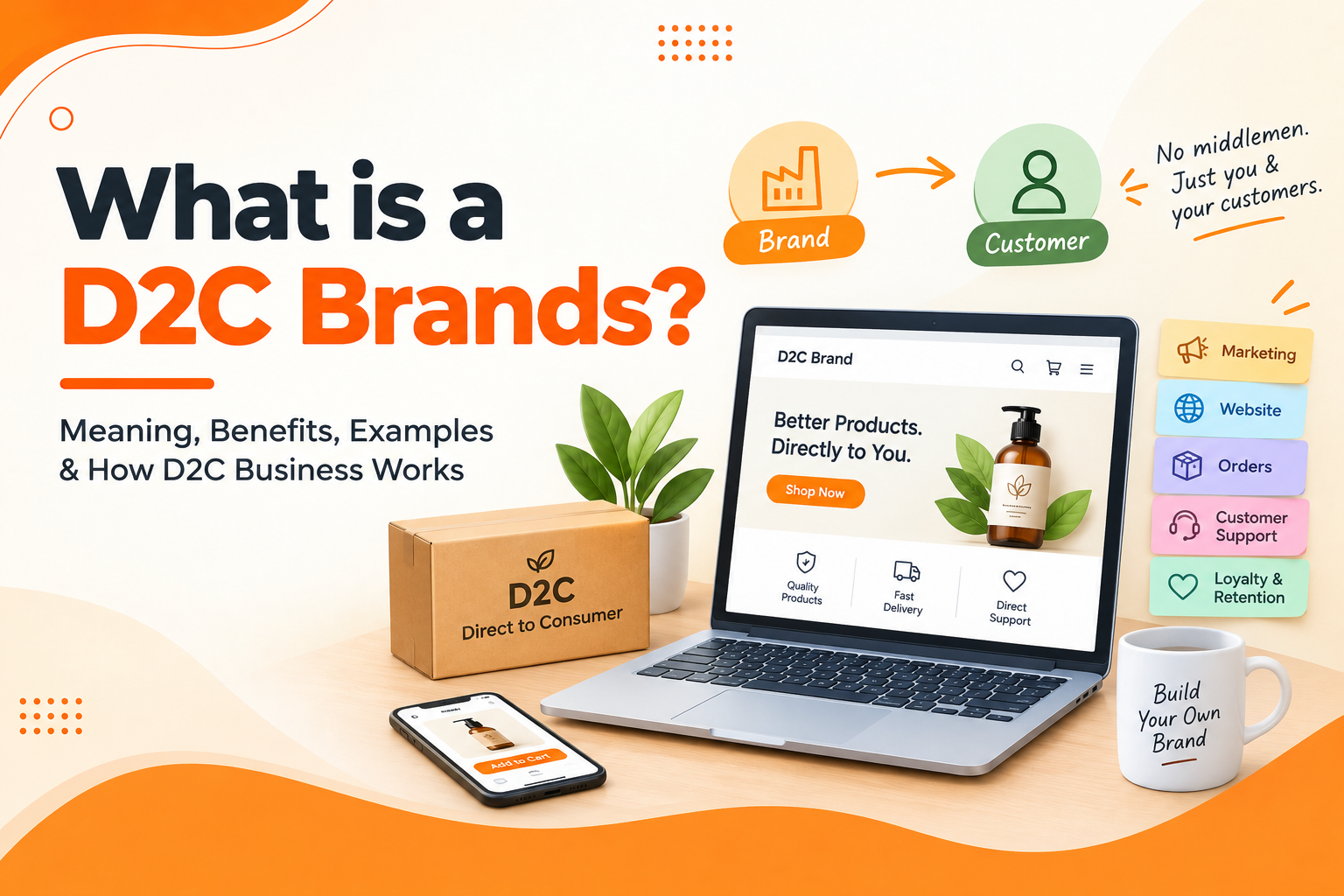
A D2C brand stands for Direct-to-Consumer brand. It is a business that sells its products or services directly to customers without depending heavily on traditional middlemen such as distributors, wholesalers, or retail stores.
For example, imagine a skincare brand that manufactures its own products and sells them through its website. A customer discovers the brand through an Instagram ad, visits the website, places an order, and receives the product at home.
There is no traditional retailer involved in this process.
This is the basic idea behind what is D2C brand.
The brand controls important parts of the customer journey, including marketing, website experience, pricing, customer communication, order processing, and after-sales support.
D2C Full Form
The D2C full form is Direct-to-Consumer.
The term explains the business model itself. "Direct" means the company sells directly, while "Consumer" refers to the final customer purchasing the product.
Unlike traditional businesses that may use several distribution layers, a D2C business tries to create a direct relationship between the brand and its customers.
D2C Brands Meaning
The D2C brands meaning becomes easier to understand when we compare it with a traditional business model.
In a traditional model, a product may move through several stages:
Manufacturer → Distributor → Wholesaler → Retailer → Customer
In a D2C model, the journey can be much shorter:
Brand → Customer
For example, a D2C clothing brand can manufacture or source its products, promote them through Instagram and Google, sell them through its website, and deliver them directly to customers.
This gives the brand more control over the overall customer experience.
How Does a D2C Business Work?
A D2C business generally uses digital platforms to attract customers and sell products. The process can look like this:
1. Product Creation
The brand first develops or sources a product based on customer demand. This could be anything from cosmetics and clothing to food products or fitness equipment.
2. Building an Online Store
The brand creates a website or online store where customers can learn about products, check prices, read reviews, and place orders.
3. Digital Marketing
D2C brands use channels such as Google Ads, Meta Ads, Instagram, YouTube, SEO, influencers, and email marketing to reach potential customers.
4. Customer Places an Order
Once a customer decides to purchase, they complete the checkout process on the brand's website or another online platform.
5. Product Delivery
The order is processed and shipped directly to the customer through a logistics or delivery partner.
6. Customer Retention
After the purchase, the brand can use email, WhatsApp, SMS, loyalty programs, remarketing, and other channels to encourage repeat purchases.
This complete journey makes customer data extremely valuable for a D2C business.
Why Are D2C Brands Growing?
One major reason behind the growth of D2C brands is the rapid growth of online shopping.
Customers can now discover a new product through a social media Reel, search for reviews on Google, visit the website, and purchase the product within minutes.
Digital advertising has also made it easier for smaller brands to reach specific audiences without opening hundreds of physical stores.
For example, a new skincare brand can target people interested in skincare, beauty, or a specific skin concern through digital advertising.
This ability to reach a focused audience has created new opportunities for D2C businesses.
Benefits of a D2C Business
Direct Customer Relationship
One of the biggest advantages of a D2C model is the direct relationship with customers. The brand can communicate with customers without depending entirely on retailers.
Better Customer Data
D2C brands can collect useful information about customer behaviour, such as products viewed, purchases, repeat orders, and website interactions.
This information can help businesses improve their marketing and products.
More Control Over Branding
A D2C brand can control how its products are presented, from website design and packaging to advertisements and customer communication.
Faster Customer Feedback
Customers can directly share reviews, complaints, suggestions, and product feedback with the brand. This can help the business understand what customers actually want.
Personalised Marketing
Because D2C brands have direct access to customer interactions, they can create personalised offers, recommendations, and remarketing campaigns.
Challenges of D2C Brands
Although the D2C model has many advantages, it also comes with challenges.
Customer acquisition can be expensive because brands often need to spend money on advertising to attract new customers.
Competition is another major challenge. Customers have thousands of products to choose from, so a D2C brand needs strong branding, good products, customer reviews, and a smooth buying experience.
D2C businesses also need to manage logistics, returns, customer support, inventory, payment processing, and website performance.
Therefore, having a website alone is not enough. A successful D2C business needs a complete customer acquisition and retention strategy.
D2C India: Growth of D2C Brands in India
The D2C India market has grown significantly with the rise of smartphones, digital payments, social media, and online shopping.
Indian customers are increasingly comfortable discovering and purchasing products online. This has created opportunities for both new startups and traditional businesses to build direct relationships with customers.
Many Indian D2C brands operate in categories such as beauty, fashion, food, personal care, home products, fitness, and lifestyle.
Social media has played an important role in this growth. A brand can create content, build a community, work with creators, run advertisements, and send customers directly to its website.
This makes D2C India an important part of the country's growing digital commerce ecosystem.
D2C Brand vs Traditional Brand
The biggest difference between a D2C brand and a traditional brand is the relationship with the customer.
A traditional brand may depend on distributors and retailers to reach customers, while a D2C business focuses on selling directly through its own digital channels.
| D2C Brand | Traditional Brand |
|---|---|
| Sells directly to customers | Often uses distributors and retailers |
| More control over customer experience | Retailers may control part of the experience |
| Direct access to customer data | Customer data may be limited |
| Strong focus on digital marketing | Often depends on offline distribution |
| Direct customer feedback | Feedback may pass through intermediaries |
Both models can work successfully. The right model depends on the product, target audience, distribution strategy, and business goals.
Examples of D2C Business Channels
A modern D2C business does not necessarily depend on only one platform. Brands commonly use multiple channels, including:
- Brand website
- Instagram and Facebook
- Google Search
- Google Shopping
- YouTube
- Email marketing
- Influencer marketing
- Mobile applications
- Online marketplaces
The goal is to bring customers into the brand's ecosystem and create a strong relationship beyond a single purchase.
Final Thoughts
So, what is D2C brand?
A D2C brand is a business that sells directly to its customers, usually through digital channels, instead of relying completely on traditional distribution networks.
The D2C full form is Direct-to-Consumer, and the model gives businesses greater control over branding, customer relationships, marketing, and customer data.
With the growth of e-commerce, social media, digital advertising, and online payments, the D2C business model has become an important part of modern commerce.
For businesses in D2C India, the opportunity is not only about selling products online. It is about building a strong brand, understanding customers, creating a smooth buying journey, and turning first-time buyers into repeat customers.