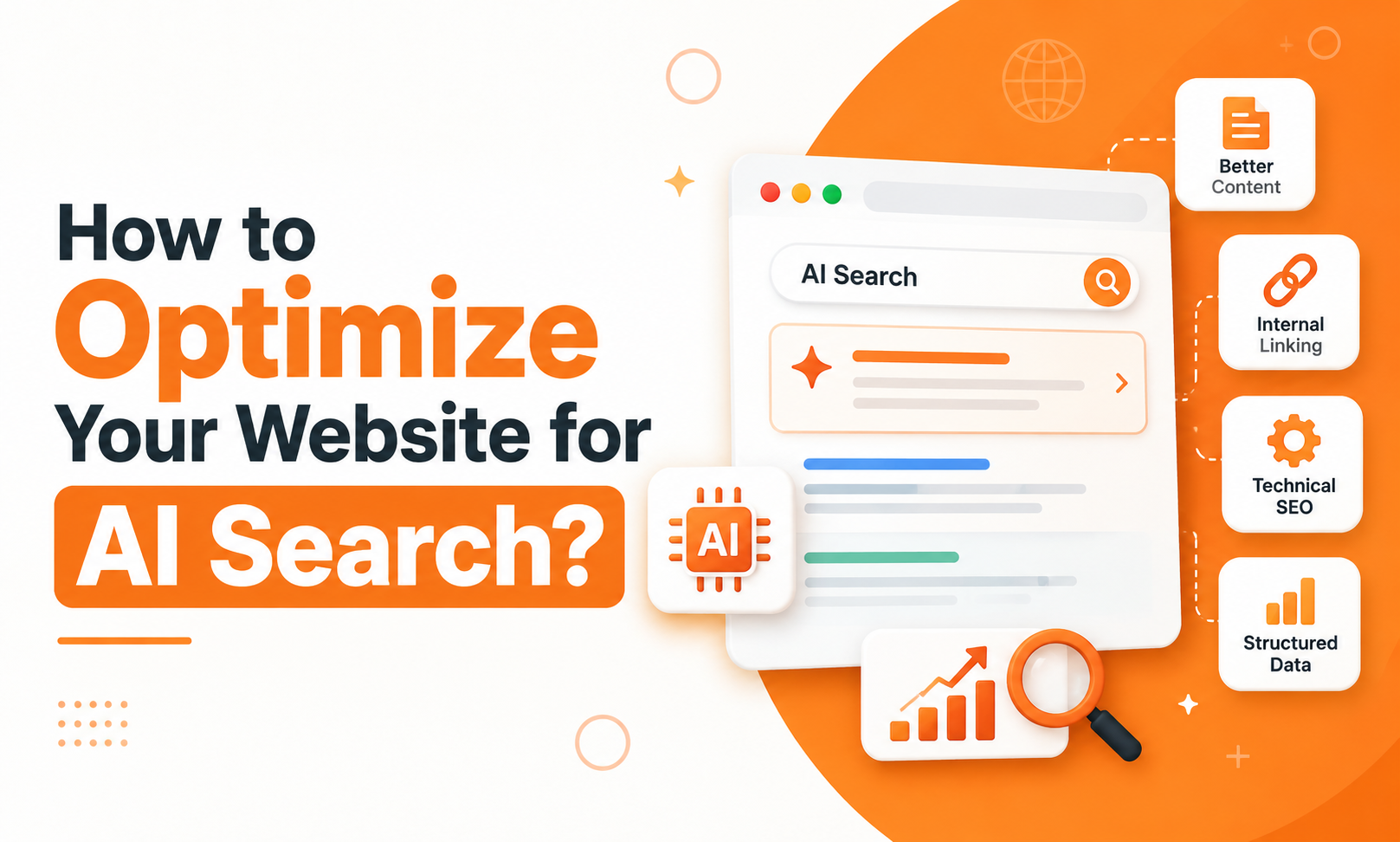
How to Optimize Your Website for AI Search?
Search is changing quickly. People are no longer using Google only to find websites and read different pages. Today, users are also asking questions directly to AI tools such as ChatGPT, Google AI Overviews, Gemini, Perplexity, and other AI-powered search platforms.
This change has created a new opportunity for businesses: AI Search.
If your website is easy for AI systems to understand, your content can become a source for AI-generated answers. This can help your brand get more visibility, traffic, mentions, and potential customers.
But how do you optimize a website for AI Search?
In this guide, we will explain AI Search in SEO, how AI search engines understand websites, how to rank on AI, and the most important steps for effective website optimization.
What Is AI Search?
AI Search is a way of searching where artificial intelligence understands a user's question and provides a direct, detailed answer instead of simply showing a list of website links.
Traditional search usually works like this:
User Search → Search Results → Website → Answer
AI Search can work more like:
User Question → AI Understands Intent → Information From Multiple Sources → Direct Answer
For example, instead of searching:
“Best digital marketing agency in Delhi”
a user may ask an AI search platform:
“Which digital marketing agencies in Delhi are good for SEO and Google Ads?”
The AI can understand the complete question, compare information, and provide a more useful answer.
This is why businesses now need to think beyond traditional SEO and start focusing on AI Search optimization.
Why Is AI Search Important for SEO?
AI Search does not mean that traditional SEO is dead. In fact, strong SEO can help your website become more useful for AI systems.
Search engines and AI platforms need reliable, structured, and relevant information to understand websites. Your existing SEO foundation can support this process.
This is where AI Search in SEO becomes important.
Traditional SEO focuses heavily on ranking webpages for specific searches. AI Search focuses more on whether your content can provide a clear and useful answer to a user's complete question.
For example, instead of creating an article only around the keyword “SEO cost,” you should answer related questions such as:
-
How much does SEO cost?
-
What affects SEO pricing?
-
What does an SEO agency include?
-
How long does SEO take?
-
Is SEO worth the investment?
When your content answers related questions clearly, it becomes more useful for both users and AI systems.
How Does AI Search Understand Your Website?
AI systems use different signals to understand content, entities, topics, websites, and relationships between information.
Your website should therefore make its information easy to understand.
Some important factors include:
Relevant content: Your content should directly answer the user's question.
Topical authority: Your website should cover a subject in depth instead of publishing random articles.
Clear structure: Headings, paragraphs, lists, FAQs, and tables can make information easier to understand.
Trust signals: Author information, business details, references, reviews, and reliable information can strengthen credibility.
Technical SEO: Search engines still need to crawl, index, and understand your website properly.
This means good website optimization remains one of the foundations of AI Search visibility.
1. Create Content That Answers Real Questions
One of the best ways to prepare your website for AI Search is to understand what your audience actually wants to know.
Do not create content only because a keyword has search volume.
Think about the complete question behind the keyword.
For example, if your main topic is “digital marketing cost,” your article should not simply repeat that phrase.
Instead, explain:
-
Average digital marketing costs
-
Different pricing models
-
Factors that affect pricing
-
Agency vs freelancer costs
-
SEO, PPC, and social media costs
-
What businesses should expect from an agency
This gives AI systems more useful information to understand and potentially use in an answer.
2. Build Strong Topic Clusters
A single article is rarely enough to establish strong topical authority.
Suppose you have a digital marketing agency website. You can create a topic cluster around digital marketing.
Your main page could target:
Digital Marketing Services
Supporting blogs could cover:
-
What Is Digital Marketing?
-
Digital Marketing Strategy
-
Digital Marketing Cost
-
SEO vs Google Ads
-
Social Media Marketing
-
Performance Marketing
-
AI Search
-
Generative Engine Optimization
-
Google Business Profile Optimization
Then connect these pages using relevant internal links.
This helps search engines understand the relationship between your content and can also create a stronger information network for AI Search.
3. Write Direct and Clear Answers
AI systems need to understand information quickly.
Avoid making users read five paragraphs before finding the answer.
For important questions, provide a direct answer first and then explain it in detail.
For example:
What is AI Search?
AI Search uses artificial intelligence to understand a user's query and provide a direct answer using information from relevant sources.
Then continue with a deeper explanation.
This format is useful for users and makes your content easier to understand.
4. Use Natural Language and Related Keywords
Do not focus on repeating the same keyword again and again.
Instead, use related terms naturally throughout the article.
For an AI Search article, supporting keywords can include:
-
AI search optimization
-
AI search engines
-
AI search SEO
-
AI-powered search
-
AI Overviews
-
Generative Engine Optimization
-
Answer Engine Optimization
-
AI search ranking
-
website optimization
-
search engine optimization
This gives your content broader topical coverage.
Keyword proximity also matters. Keep important terms close to the concepts they describe instead of placing keywords randomly throughout the article.
5. Improve Your Website's Technical SEO
Content is important, but technical website optimization should not be ignored.
Make sure your website:
-
Can be crawled by search engines
-
Has important pages indexed
-
Loads quickly
-
Works well on mobile devices
-
Uses HTTPS
-
Has a clean URL structure
-
Uses proper internal linking
-
Has XML sitemaps
-
Avoids unnecessary duplicate pages
AI Search does not replace technical SEO.
If search engines cannot properly access or understand your website, your content has less chance of being discovered and used.
6. Add Structured Data Where Relevant
Structured data helps search engines understand what information exists on a webpage.
Depending on your page, you can use relevant schema types such as:
-
Article Schema
-
Organization Schema
-
LocalBusiness Schema
-
Product Schema
-
Review Schema
-
FAQ Schema
-
Breadcrumb Schema
Do not add schema simply for the sake of adding it. Use structured data when it accurately represents the content on your page.
Better structured information can support your overall AI Search and SEO strategy.
7. Build Trust and Demonstrate Experience
AI systems need reliable information.
This means your website should clearly show who is behind the content and why users should trust your business.
Add useful trust signals such as:
-
Author information
-
Company information
-
Contact details
-
Client case studies
-
Reviews and testimonials
-
Real examples
-
Original research
-
Statistics with reliable sources
-
Experience-based insights
For example, if you are writing about SEO, explaining something from real client experience can make the content more valuable than simply rewriting information available on other websites.
8. Make Your Content Easy to Extract and Understand
If you want to rank on AI, focus on clarity.
Use:
-
Short paragraphs
-
Descriptive headings
-
Bullet points
-
Numbered steps
-
Definitions
-
Comparisons
-
Examples
-
FAQs
For complex topics, explain the concept first and then provide examples.
This creates content that is easier for humans to read and easier for machines to understand.
Can You Actually Rank on AI Search?
Yes, but AI Search visibility is different from traditional Google rankings.
There is no simple trick that guarantees your website will appear in every AI answer.
Instead, focus on becoming a reliable and useful source for your topic.
A strong strategy includes:
Quality SEO + Helpful Content + Topical Authority + Technical SEO + Brand Trust + Clear Information
These elements can increase the chances of your website being discovered, understood, referenced, or mentioned by AI-powered search experiences.
AI Search vs Traditional SEO
Traditional SEO and AI Search should not be treated as two completely separate strategies.
Traditional SEO focuses on ranking webpages in search results.
AI Search focuses more on providing useful answers and information through AI-generated responses.
However, both need:
-
High-quality content
-
Strong technical foundations
-
Relevant topics
-
Good user experience
-
Trust
-
Authority
-
Clear information
Therefore, the best approach is not to stop doing SEO. Instead, improve your existing SEO strategy so your website is prepared for the changing search experience.
Final Thoughts
AI Search is changing how people discover information online. Businesses that only focus on traditional keyword rankings may miss new opportunities as users increasingly search through AI-powered platforms.
The good news is that the fundamentals remain similar.
Create helpful content, answer real questions, build topical authority, improve technical SEO, use relevant structured data, and show genuine expertise.
If you want to rank on AI, don't create content only for algorithms. Create content that gives people the best possible answer.
That is the foundation of modern AI Search in SEO and effective website optimization.