
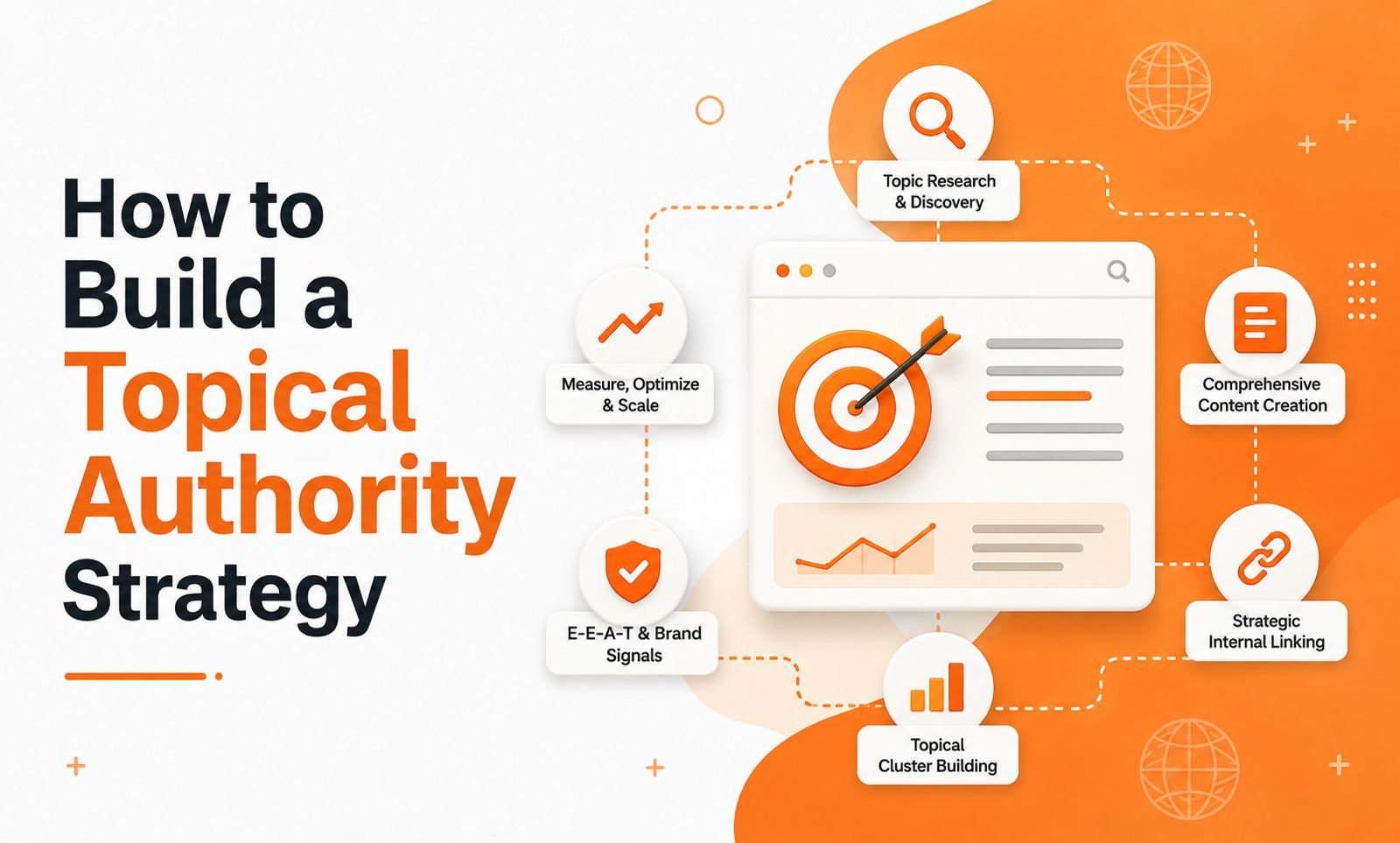
How to Build a Topical Authority Strategy
Introduction
Ranking well on Google has become increasingly difficult due to continuous advancements in search engine technology and how they perceive content. It is not enough just to publish several blog posts containing the necessary keywords to secure long-term exposure. Nowadays, websites which thoroughly discuss the topic have higher chances of gaining trust from both visitors and search engines. For this reason, building Topical Authority is a must for every SEO Strategy.
Instead of writing isolated pieces of content, successful websites concentrate on publishing related articles answering various questions about one and the same topic. Having content structured through Content Clusters and Topic Maps, search engines will better perceive your knowledge about the field. Meanwhile, visitors will have less trouble finding relevant information, staying within the limits of your site.
This guide describes how to build a strategy allowing you to enhance the authority of your website, organic visibility and SEO results.
Why Topical Authority Matters in Modern SEO
The search engines aim at recommending websites offering comprehensive, reliable, and valuable information. In addition to checking the presence of certain keywords on webpages, they analyze whether a website is covering the entire topic or not.
For example, let’s assume there are two websites talking about digital marketing. One website has a few blogs on SEO; the other has detailed guides on keyword research, on-page SEO, technical SEO, local SEO, content marketing, link building, website performance, and user experience. The latter is more knowledgeable as it is covering the topic from different perspectives.
The more useful information the users will get from the website, the more time they will be spending browsing through different pages, which will positively influence their credibility and ranking on different topics.
Choose a Clear Topic Before Creating Content
The key to having a successful authority site is determining your main focus before even writing your first blog. Determine what specific field your business falls under or what product it sells and use it as your main subject.
For example, if your business provides digital marketing services, your main subject may be SEO, social media marketing, paid advertisements, content marketing or website optimization.
By choosing only one particular area, you will be able to accumulate knowledge on the chosen topic instead of posting unconnected information that may confuse your audience and the search engines.
When you determine your main subject, try to think of all the questions your customers may have. Newbies may be looking for explanations, more experienced users – for advanced methods, comparisons or trends. In this way, your website will become a reliable source of information for people with various search intents.Careful planning of the content will also help to avoid duplicating the articles.
Build Your Website Around Content Clusters
One of the best ways to make the structure of your website organized is Content Clusters. It implies that you group the pages by the similar topics and each of them helps other pages.
You start with creating one general pillar page with the general theme described in detail. Once the pillar page is created, you create the supporting pages that cover the separate subject in depth. The supporting pages will lead to the main guide as well as to other pages within your website.
For instance, if the general theme of the pillar page is SEO, then the list of blogs can include keyword research, technical SEO, image optimization, internal links, local SEO, website speed, schema markup, and content optimization. In this way, all of the themes combine into one learning process.
Such structure helps users navigate easily through different topics on your website.
Use Topic Maps to Plan Content Before You Write
There are many websites where writers post their articles without any content roadmap. As a result, ideas are repeated, chances are missed and the website is poorly structured.
Preparation of Topic Maps will help you organize your content better. You should begin with positioning your main topic at the center of your map. Then, divide it into key categories and develop each one to form smaller blog ideas which can be used to answer the questions from your users.
For instance, you can write about crawlability, indexing, Core Web Vitals, XML sitemaps, structured data and website architecture when it comes to technical SEO. As for the content marketing, you can write about blogging, evergreen content, content optimization and audience research.
In this way, you make sure that all the articles have their specific place and purpose within the website. In addition, you can find content gaps which your competitors do not fill.
Understand Search Intent Before Writing Any Article
The first major issue preventing content from ranking is the fact that the focus of content creators is on keywords rather than on what people really want.
When you are about to write your blog post, you need to figure out why people search for such information. Do they look for basic facts, instructions, expert opinions, comparisons, or professional help?
Analyzing existing search results will give you an idea of what people expect to find. You should pay close attention to existing articles that rank high, to the questions they solve, and to the questions they ignore.
Your objective should always be to create content that is more understandable and helpful than those you see already ranking.
Strengthen Your Internal Linking Structure
While creating high-quality content is essential in establishing a successful website, another factor that also contributes to the ability of search engines to comprehend your content is how you link different pages within the website.
Every time a blog is released, link it internally to other relevant pieces of content in your website rather than solely for SEO purposes. This will allow the reader to get access to the information which might be relevant in the context of what he or she is currently reading. For instance, if a person is reading about keyword research, then it is also advisable to link him or her to blogs on on-page SEO, search intent, or website optimization.
Focus on Quality Instead of Publishing More Articles
However, many websites consider posting many blogs a surefire way to increase rankings. On the contrary, search engines prefer informative, elaborate and reliable content rather than a lot of small articles.
All the blogs have to provide a complete answer to the user's query in an understandable form. One has to use simple language, clear headings and examples. Redundant repetitions of the same things for the sake of increasing the number of words are not welcomed. The audience likes concise and informative content.
Besides, one has to be consistent. Posting one good article a week is better than posting several bad ones at once. The more the content increases, the more valuable your site becomes within your niche.
Keep Your Content Fresh and Relevant
SEO is not a one-off process. With changes in the interests of users, the search itself, and search engines, there will be constant changes to your content too.
Review your old articles frequently and update them with new data, examples, explanations, or even add new sections that respond to new user queries. Updating old content tends to be more effective than writing a new article because the page may already be ranking for some search queries.
Updating old pages also helps to show the search engines that your site is still active.
Measure Your Progress and Improve Over Time
Authority requires time and patience, hence the need for constant monitoring of your website's progress.
Keep tabs on all SEO factors, including organic traffic, keyword rankings, click-through rate, time spent, and page performance. This will enable you to know which topics draw in the most visitors and which pages require work.
Also look out for pages that have impressions yet generate very few clicks or are ranked on the second page of Google results. With small changes to your pages' titles, content, and internal links, you will easily improve their ranking positions.
Good websites do not just guess; they measure and optimize their strategies through consistent performance analysis.
Common Mistakes That Prevent Authority Growth
The reason for such problems is the absence of strategy when articles are written for the website. Writing articles just because the keywords are popular might harm the general theme of your website.
Also, many people make mistakes when they create several blogs targeting the same keywords. In this case, you will fight against yourself, not against other competitors.
Not creating links to other pages inside the website, posting thin content, and forgetting to update older articles are other reasons why you could lose your rankings.
It is better to concentrate on valuable content supporting the main theme of your site rather than try to follow all trending keywords.
Build Trust Through Helpful Content
The websites that succeed in the long term are those that provide useful information consistently. The sites that the users can rely on and recommend to others as well as spend much time on will attract the attention of people.
Forget about rankings and begin creating useful articles for the users who need your help. The more useful your articles are for the users, the more trustworthy you become in the opinion of search engines.
Trust builds up gradually, with each valuable article.
Conclusion
Creating Topical Authority is a strategic process that will make your site authoritative in your industry over time. Rather than posting unrelated content, concentrate on valuable articles that provide the answers to various questions related to the primary topic. Use Content Clusters to structure your website, apply Topic Maps to plan upcoming content and follow a proper SEO strategy that prioritizes user needs.
As the content expands and the pages are interconnected, the search engine gains an insight into your expertise. Together with the frequent updating, natural interlinking and quality content, this approach will positively impact your organic presence and help your website grow for years to come.
Blog FAQs
Frequently Asked Questions
Topical authority is the process of building expertise around a specific subject by creating helpful and connected content. It helps search engines recognize your website as a trusted source for that topic.
Content clusters organize related articles around one main topic, making it easier for users to find information and helping search engines understand your website's content structure.
Topic maps help organize content ideas before publishing. They ensure every article supports your main topic, reduces duplicate content, and creates a clear roadmap for future blogs.
Building topical authority is a long-term process that depends on content quality, consistency, competition, and website optimization. With regular publishing and updates, results often become noticeable over several months.
Start by choosing one core topic related to your business, create a detailed pillar page, publish supporting articles around it, and connect them with natural internal links to build a strong content structure.