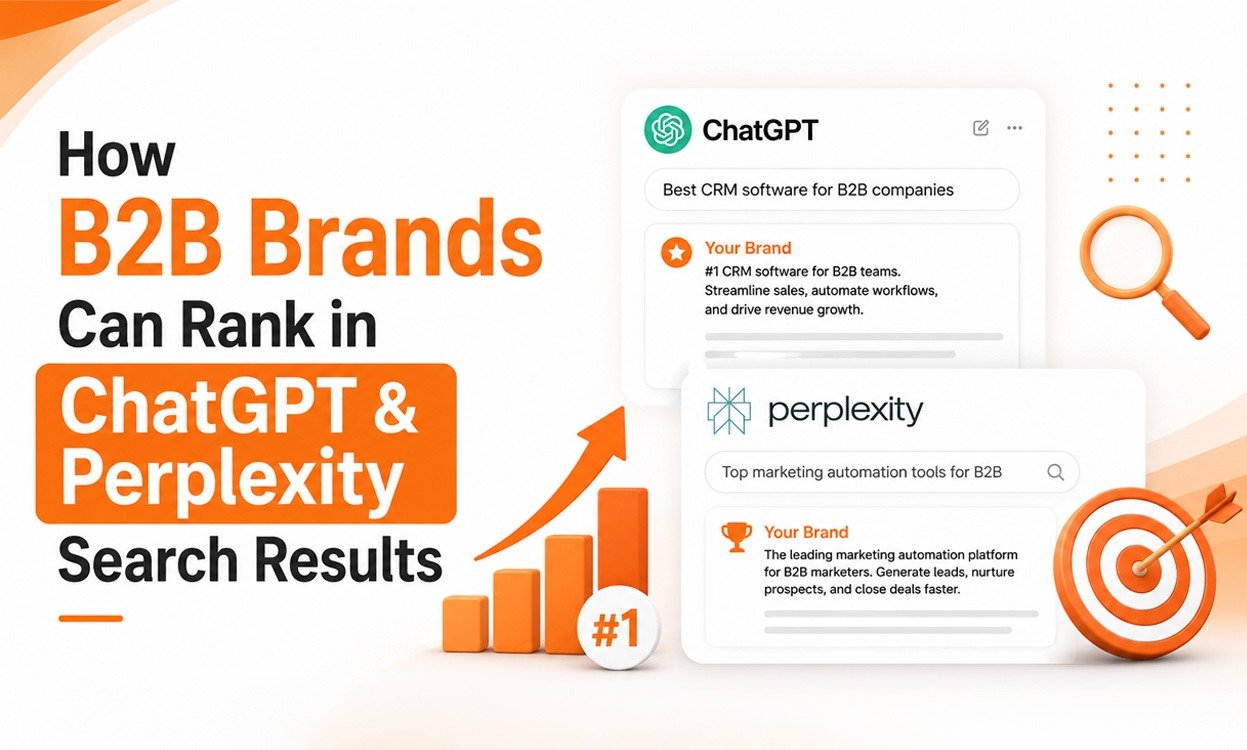
How B2B Brands Can Rank in ChatGPT & Perplexity Search Results
Most businesses have spent years trying to rank on Google. Now, people are also asking questions on ChatGPT, Perplexity, and other AI search platforms before they visit a website. This small change is creating a new opportunity for B2B companies.
If your business wants more leads, better visibility, and stronger brand awareness, it is no longer enough to focus only on traditional SEO. Your content also needs to be easy for AI tools to understand and recommend.
Many business owners are now asking How B2B Brands Can Rank in ChatGPT & Perplexity Search Results because these platforms are becoming a trusted source for research. When someone searches for the best software, marketing agency, consulting service, or SaaS solution, AI search engines often summarize information from multiple trusted websites instead of showing only a list of links.
This guide explains practical methods that help B2B brands increase their chances of appearing in AI-generated answers while also improving their Google rankings.
Why AI Search Matters for B2B Companies
Business buyers rarely make quick decisions. They compare products, read case studies, check reviews, and look for expert advice before contacting a company.
Today, many of these research steps begin inside AI search tools. Instead of opening ten browser tabs, users ask one detailed question and receive a complete answer.
This means your website should provide information that AI systems can easily understand and trust. If your content clearly answers common business questions, there is a better chance that it will be referenced when users search through AI assistants.
Rather than replacing traditional SEO, AI search optimization works alongside it. Strong websites usually perform well across both search engines and AI platforms because they focus on quality information.
How ChatGPT and Perplexity Find Information
Although these platforms work differently, both try to provide accurate and useful answers.
They often rely on trusted websites, authoritative content, structured information, recent updates, and pages that explain topics clearly. Content that answers one question completely usually performs better than pages that only repeat keywords.
For B2B companies, this means every article should solve a real problem instead of trying to rank for one keyword alone.
If your content helps users understand a topic from beginning to end, AI search engines are more likely to recognize its value.
Build Content Around Real Business Questions
Many companies write blogs only to target keywords. A better approach is to answer the exact questions your customers ask before making a purchase.
Think about the conversations your sales team has every week. Those questions can become valuable blog topics.
For example, instead of writing only about CRM software, explain how to choose CRM software for small businesses, compare different solutions, discuss pricing factors, implementation challenges, and common mistakes.
This creates complete content that serves both search engines and readers.
When someone asks ChatGPT a similar question, your article has a stronger chance of matching the intent behind the query.
Create Topical Authority Instead of Random Blogs
Publishing one article is rarely enough.
Search engines and AI platforms prefer websites that consistently cover one subject in depth. This is known as topical authority.
Suppose your company sells project management software. Rather than writing about unrelated business topics, create multiple articles around project planning, workflow automation, team collaboration, productivity, project reporting, remote work management, and software implementation.
As these articles connect with each other, they build trust and show expertise.
Over time, your website becomes a stronger resource for both users and AI systems.
Make Your Content Easy to Understand
AI models prefer content that is simple, organized, and informative.
Avoid long paragraphs filled with difficult words. Explain concepts in plain English. Use meaningful headings that describe the next section instead of using creative titles that hide the topic.
Each paragraph should focus on one idea before moving to the next.
This improves readability and helps AI understand the relationship between different sections of your page.
Simple writing also keeps readers engaged for longer, which can improve user experience signals.
Focus on EEAT
Experience, Expertise, Authoritativeness, and Trustworthiness continue to play an important role in modern SEO.
Readers want to know who created the content and whether the information is reliable.
Include author information, company details, original insights, real examples, and updated statistics whenever possible.
If your business has completed successful projects, share those experiences naturally within your content.
Practical examples often provide more value than generic advice.
This also increases credibility in the eyes of both users and AI-powered search systems.
Improve Your Technical SEO
Good content alone cannot solve every ranking problem.
Your website should load quickly, work properly on mobile devices, and have a clean page structure.
Broken links, duplicate pages, poor navigation, and slow loading times reduce overall quality.
Search engines find it easier to understand websites that use clear URLs, proper heading hierarchy, internal links, image optimization, and structured data where appropriate.
Technical improvements make your content easier to crawl, index, and recommend.
Publish Original Research and Case Studies
Original information is becoming more valuable than ever.
Many websites repeat the same advice. AI systems already know that information.
Instead, publish something unique.
Share customer success stories, industry surveys, performance data, market trends, or lessons learned from real projects.
Original content gives AI platforms a stronger reason to reference your website because the information cannot be found everywhere else.
Even a simple case study showing how a client improved results after using your service can become valuable content.
Keep Your Content Updated
Business information changes regularly.
An article published two years ago may still receive traffic, but outdated facts reduce its usefulness.
Review important pages every few months.
Add recent examples, update statistics, improve explanations, and answer new customer questions.
Fresh content sends positive quality signals and keeps your website relevant.
Regular updates also increase the chances of appearing in AI-generated answers that prioritize current information.
Build Brand Mentions Across the Web
Search visibility is no longer based only on backlinks.
Mentions of your company on trusted websites, business directories, industry publications, podcasts, interviews, and professional communities help strengthen your online presence.
A consistent brand identity across different platforms makes your business easier to recognize.
When multiple trusted sources mention your company, AI systems gain additional confidence that your brand is legitimate.
This supports both AI search optimization and traditional search rankings.
Optimize for Search Intent
Every search has a purpose.
Some users want to learn, while others are ready to compare products or contact a company.
Your content should match that intent.
Educational blogs should explain topics clearly without becoming promotional too early.
Comparison pages should provide honest evaluations.
Service pages should explain benefits, pricing, and next steps.
Matching user intent creates a better experience, which often leads to stronger rankings over time.
Internal Linking Still Makes a Difference
Many businesses ignore internal links, but they remain valuable.
When one article naturally connects to another related page, readers spend more time exploring your website.
It also helps search engines understand how different topics are connected.
Instead of adding links randomly, connect pages that genuinely provide additional value.
A strong internal linking strategy supports both content discovery and topical authority.
Write for People First
Some websites still try to rank by repeating the same keyword again and again.
This approach no longer works well.
Instead of forcing keywords into every paragraph, use natural language.
Discuss related topics, answer follow-up questions, and explain ideas clearly.
Search engines have become much better at understanding context.
This means semantic SEO, related phrases, and topic relevance are often more valuable than excessive keyword repetition.
That is why successful B2B content sounds natural while still covering important search terms.
Final Thoughts
Businesses are entering a new phase of search where visibility depends on more than Google rankings alone. Companies that create useful, trustworthy, and well-structured content have a better chance of being discovered across multiple platforms.
If you are wondering How B2B Brands Can Rank in ChatGPT & Perplexity Search Results, the answer is simple. Build content that genuinely helps your audience, organize your website around clear topics, improve technical SEO, publish original insights, and update your information regularly.
The goal is not to write for algorithms. The goal is to become the best source of information in your industry. When your content consistently solves real business problems, both search engines and AI platforms are far more likely to recommend it to the people looking for answers.
Blog FAQs
Frequently Asked Questions
B2B brands can improve their visibility by publishing helpful content, building topical authority, and following SEO best practices.
Answer Engine Optimization (AEO) is the process of optimizing content so AI search platforms can easily understand and recommend it.
Yes. Strong SEO, quality content, technical optimization, and website authority all support better visibility in AI-powered search.
Detailed guides, expert insights, case studies, and content that clearly answers user questions perform best in AI search.
Optimizing for AI search helps B2B businesses improve online visibility, reach potential customers, and generate more qualified leads.